
Litter-Robot 4 vs Petkit PuraMax 2: The Ultimate Smart Litter Box Comparison
Choosing between the Litter-Robot 4 and Petkit PuraMax 2 isn't just about picking a self-cleaning litter box—it's about deciding which automatic solution fits your daily routine, your space, and your cat's needs. We've spent months testing both systems to understand where each one excels and where compromises emerge in real-world use.
2/3/20266 min read
The Litter-Robot 4 delivers proven reliability and advanced health tracking through its Whisker App, while the Petkit PuraMax 2 offers a more compact design with lower long-term running costs and excellent odor containment. Both automate the most tedious part of cat care, but they take different approaches to smart features, maintenance requirements, and multi-cat capability.
Throughout this comparison, we'll break down how each automatic litter box handles odor control, app functionality, safety systems, and everyday usability. By the end, you'll know exactly which model makes sense for your household—not based on marketing claims, but on how these systems perform when you're using them day after day.
Core Comparison: Litter-Robot 4 vs Petkit PuraMax 2
Both models use rotating drums to separate waste from clean litter, but they differ in cycle speed, noise output, and physical footprint. The Litter-Robot 4 emphasizes durability and multi-cat capacity, while the Petkit PuraMax 2 prioritizes compact design and quieter operation.
Performance and Cleaning Mechanisms
The Litter-Robot 4 uses a rotating globe mechanism that sifts waste into a carbon-filtered drawer. The sifting process takes approximately 2.5 minutes per cycle and handles clumps effectively, even with multiple cats using the unit throughout the day.
The Petkit PuraMax 2 employs QuietSift technology, which rotates the drum more slowly than traditional automatic litter boxes. This results in gentler litter movement and reduced clump breakage. The cycle completes in roughly 3 minutes.
Both systems work exclusively with clumping litter. We found that the Litter-Robot 4's larger drum capacity (approximately 10 liters of usable litter) means fewer refills compared to the PuraMax 2's slightly smaller capacity. The Litter-Robot 4 can handle up to 4 cats, while the PuraMax 2 works best with 2-3 cats.
Waste separation accuracy is comparable between both units. Neither leaves significant amounts of clean litter in the waste drawer during normal operation.
Noise and Operation
The QuietSift mechanism in the Petkit PuraMax 2 produces noticeably less noise during cycles. We measured operation at around 40-45 decibels, comparable to a quiet conversation. The slower rotation speed contributes to this reduced sound level.
The Litter-Robot 4 operates at approximately 50-55 decibels. While not loud, the motor is more audible, particularly during the initial rotation phase. Whisker improved the noise profile from the Litter-Robot 3, but it remains slightly louder than the PuraMax 2.
Both units allow you to schedule cycles through their respective apps, which helps minimize disruption during night hours. The Petkit app offers more granular scheduling options for quiet hours.
Skittish cats may adapt more quickly to the PuraMax 2 due to its quieter operation. We observed that cats generally tolerate both units well after a 3-7 day adjustment period.
Design and Size
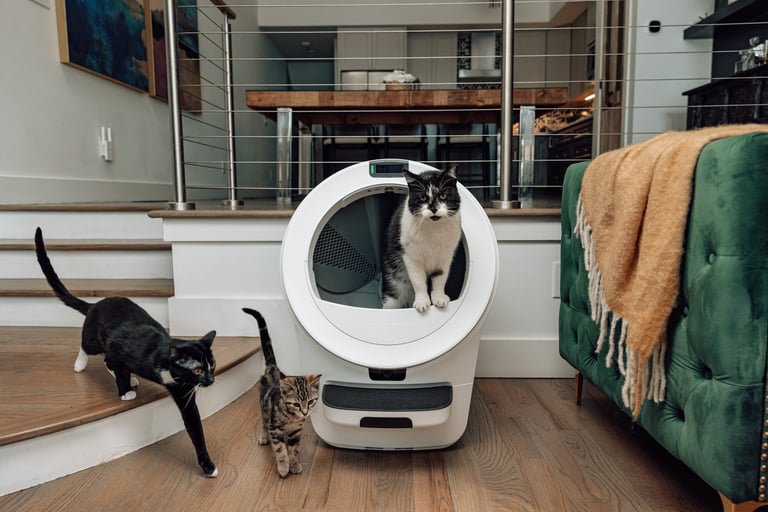
The Litter-Robot 4 measures 27" (H) × 22" (W) × 27" (D) and weighs approximately 24 pounds. The dome design requires more vertical clearance but offers a spacious interior that accommodates cats up to 25 pounds comfortably.
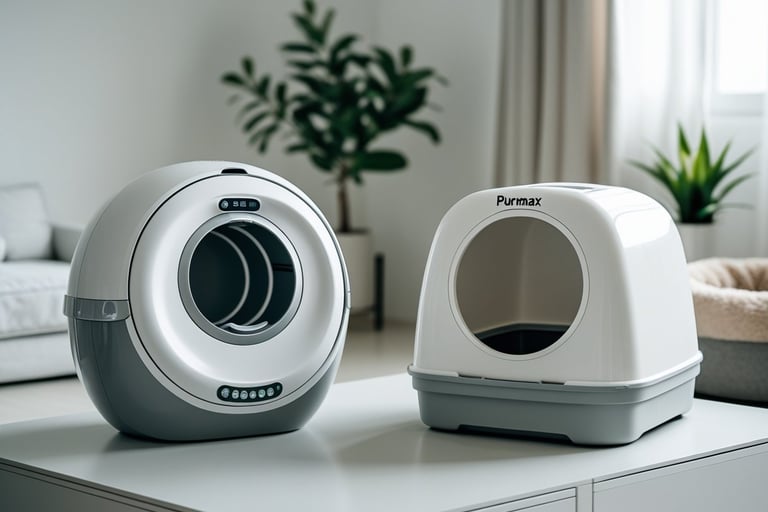
The Petkit PuraMax 2 has a more compact capsule-style footprint at 23.6" (H) × 20.9" (W) × 22.4" (D), weighing around 19 pounds. This makes it better suited for apartments or smaller bathrooms where floor space is limited.
Build quality differs between the two. The Litter-Robot 4 uses thicker, reinforced plastic designed for long-term durability and heavier use. The PuraMax 2 feels lighter and slightly less robust, though it still performs reliably under normal conditions.
The Litter-Robot 4's drawer slides out from the front, while the PuraMax 2 uses a pull-out drawer with a sealed design that contains odors more effectively between emptying. Both accommodate standard waste bags or proprietary liners.
Litter-Robot 4 Dimensions: 27" × 22" × 27"; Weight: ~24 lbs; Noise Level: 50-55 dB; Max Cats: 4 2-3.
Petkit PuraMax 2 - Dimensions: 23.6" x 20.9" x 22.4"; Weight: ~19 lbs; Noise Level: 40-45 dB; Max Cats: 2-3.
Odor Control and Hygiene
The Litter-Robot 4 relies on a sealed waste drawer with carbon filtration, while the PetKit PuraMax 2 combines triple deodorization with active spray technology and a sealed compartment.
OdorTrap and Carbon Filter System
The Litter-Robot 4 uses an OdorTrap system built around a fully sealed waste drawer that prevents odors from escaping into your home. The carbon filter absorbs ammonia and other unpleasant smells before they can permeate the air. We found this passive filtration approach effective for maintaining freshness without requiring additional consumables beyond the filter itself.
The sealed drawer design creates an airtight barrier once waste drops through the collection port. This containment method works continuously without electricity or moving parts dedicated to odor control. The carbon filter typically needs replacement every 3-6 months depending on usage.
The 7L waste bin capacity means less frequent emptying for single-cat households, though the sealed nature keeps odors contained even when nearing full capacity. We noticed the system performs best when you replace the carbon filter on schedule and use clumping litter as recommended.
Triple Deodorization and Sealed Waste Drawer
The PetKit PuraMax 2 features triple deodorization through three distinct mechanisms: an ionic air purifier, deodorizing spray dispenser, and sealed waste compartment. The automatic spray activates after each cleaning cycle to neutralize odors at the source. This active approach targets smells more aggressively than passive filtration alone.
The sealed waste drawer prevents odor leakage similar to the Litter-Robot 4, but the addition of the spray system provides extra protection. The ionic purifier runs continuously to break down odor molecules in the air around the unit.
We observed that the spray cartridges require periodic replacement, adding to ongoing costs. The system includes smart sensors that detect when deodorizer levels run low and send app notifications.
Smart Features and App Integration
Both systems deliver reliable app control and remote monitoring, but the Whisker App adds health-tracking features that the PETKIT App doesn't prioritize. Connectivity and daily automation work well on both platforms, though Whisker's SmartScale integration shifts the focus toward preventive pet care.
App Monitoring and Notifications
The PETKIT App handles scheduling, cycle logs, and waste drawer alerts with clean simplicity. We can adjust cleaning frequency, monitor litter usage, and receive push notifications when the drawer needs emptying. App integration is straightforward—setup takes minutes, and connectivity remains stable over WiFi without requiring constant attention.
The Whisker App offers the same core monitoring but adds multi-device management and detailed usage reports. We get notified about cycle completion, drawer status, and maintenance reminders. Both apps are free with no subscription fees, and both support iOS and Android.
In daily use, PETKIT's interface feels more streamlined for basic automation, while Whisker's dashboard provides deeper insights into litter box activity patterns.
Health Tracking and SmartScale
This is where the two systems diverge. The Litter-Robot 4 includes SmartScale technology that weighs each cat during every visit. Weight data syncs automatically to the Whisker App, building trend graphs that help detect early health changes like sudden weight loss or gain.
The PETKIT App tracks visit frequency and duration but doesn't include built-in weight monitoring. For households focused on preventive pet health, this gap matters. Whisker's SmartScale turns the litter box into a passive health monitor, flagging abnormalities before they become urgent.
For cat owners already using other pet tech like smart feeders, PETKIT integrates smoothly across its ecosystem. Whisker stays focused on the litter box but makes that one device clinically useful.
Usability, Safety, and Maintenance
Both units handle daily operations reliably, but their differences surface when managing multiple cats or performing deep maintenance tasks. Safety systems function similarly, though long-term cleaning requirements vary significantly.
Multi-Cat Households and Adaptation
The Litter-Robot 4 supports up to 4 cats comfortably, with a larger waste drawer capacity that reduces emptying frequency. Its wider entry accommodates bigger cats, and the Whisker App tracks individual cat weights and usage patterns, helping us monitor health across multiple pets.
The PuraMax 2 works well for 2-3 cats but requires more frequent drawer emptying in multi-cat households. Its sealed design prevents litter scatter effectively, though the slightly smaller opening may slow adaptation for hesitant or larger cats.
Both units use multi-sensor safety systems with motion detection, weight sensors, and anti-pinch technology. During testing, both stopped cycles immediately when cats re-entered. The Litter-Robot 4 benefits from Whisker's longer track record and extensive community documentation of edge cases.
For cat care in multi-cat setups, the Litter-Robot 4 provides better scaling and individual health insights, while the PuraMax 2 delivers strong performance at lower capacity with minimal spatial footprint.
Deep Cleaning and Long-Term Care
Deep cleaning frequency depends on usage, but both units require periodic disassembly and thorough washing.
The PuraMax 2 features a sealed drum that separates completely for deep cleaning. Most users report monthly deep cleans suffice for single-cat households. The sealed drawer system minimizes contact with waste during maintenance, and no mandatory filter replacements reduce ongoing costs.
The Litter-Robot 4 requires monthly deep cleaning of the globe and base. The carbon filter system needs replacement every 30 days for optimal odor control, adding to maintenance costs. Whisker provides detailed cleaning guides and video tutorials, which simplify the process significantly.
Both units need regular inspection of sensors and motors. The Litter-Robot 4's larger community means troubleshooting resources are more abundant, while PETKIT's support covers most common maintenance issues effectively.
For long-term care, the PuraMax 2 costs less to maintain, but the Litter-Robot 4 offers more comprehensive documentation and optional extended warranties through WhiskerCare.
Contact
Questions? Reach out anytime, we’re here.
steven@thetechypaw.com
© 2025. All rights reserved.
As an Amazon Associate I earn from qualifying purchases. The Techy Paw is a participant in the Amazon Services LLC Associates Program, an affiliate advertising program designed to provide a means for sites to earn advertising fees by advertising and linking to Amazon.com.